Norman's median first freeze falls on November 3, according to NOAA's 1991-2020 climate normals for the Norman 3SSE weather station. That one date splits the local pest year in two. Before it, warm and humid months drive termite swarms, mosquitoes, ticks, scorpions and brown recluse spiders. After it, mice and rats look for a way indoors. This calendar lines up NOAA's monthly temperature, rainfall and humidity normals for Norman with the seasonal windows that Oklahoma State University Extension, state and county health departments and the National Pest Management Association publish, and it ends with the pest that ignores the weather: bed bugs.
How this calendar was built: the weather figures are NOAA climate normals, which are 30-year averages, so any single year can run early or late. The pest windows come from the extension services, health departments and studies linked beside each figure. The month-by-month pressure ratings in section 2 are our summary of those published windows, not a measured index. This site connects Norman callers with independent bed bug providers.
- Norman's median first fall freeze is November 3; there is a 10% chance of one by October 21 and a 90% chance by November 17 (NOAA NCEI).
- Norman averages 37.65 inches of rain a year, 69.1 days at or above 90°F and 76.5 nights at or below 32°F (NOAA NCEI).
- July is the hottest month, with an average high of 92.5°F; January is the coldest, with an average low of 27.7°F (NOAA NCEI).
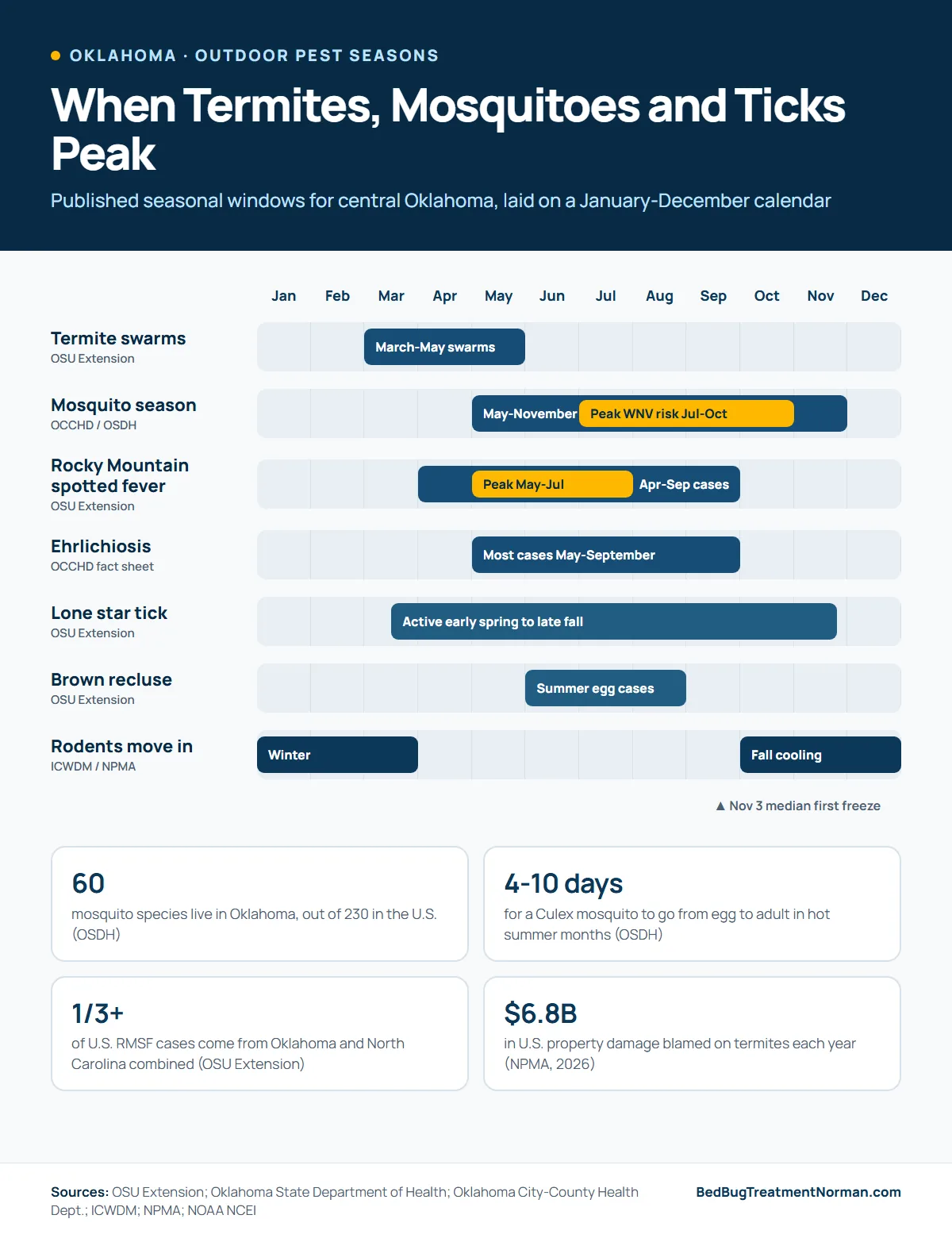
- March, April and May are Oklahoma's termite swarming months (OSU), and termites cause an estimated $6.8 billion in U.S. property damage a year (NPMA).
- Oklahoma's mosquito season typically runs May to November, with the greatest West Nile risk from July through October (OCCHD).
- Oklahoma has about 60 mosquito species; Culex mosquitoes that carry West Nile go from egg to adult in 4-10 days in hot weather (OSDH).
- A full season of mosquito control costs $373-$694 (Fixr); single visits average $80-$150 (HomeGuide).
- Most Oklahoma Rocky Mountain spotted fever cases occur April-September, peaking in May, June and July (OSU Extension).
- Oklahoma and North Carolina together account for more than a third of U.S. RMSF cases each year (OSU Extension).
- One Kansas home yielded 2,055 brown recluse spiders in six months with no bites; a typical infested Oklahoma home yielded 30 (Journal of Medical Entomology).
- Rodents invade an estimated 21 million U.S. homes each winter, and 24% of homeowners report mice in winter (NPMA).
- Bed bug reports in a four-year Philadelphia study peaked in August and hit their low in February (Mabud et al.).
- 51% of pest professionals say bed bugs are most active in summer (Bugs Without Borders), and Oklahoma City rose to No. 24 on Orkin's 2026 bed bug list (Orkin).
1. Norman's Climate by Month: The NOAA Normals
Pests respond to temperature and moisture, so the calendar starts with the weather. NOAA's 1991-2020 normals for the Norman 3SSE station give the average daily high and low, rainfall, freezing nights and 90-degree days for each month. Norman's station does not record humidity, so the dew point and humidity columns come from NOAA's hourly normals for Oklahoma City's Will Rogers airport, the nearest first-order NOAA station, north of Norman.
| Month | Avg high | Avg low | Rain (in) | Nights ≤32°F | Days ≥90°F | Dew point (OKC) | Humidity (OKC) |
|---|---|---|---|---|---|---|---|
| January | 49.9°F | 27.7°F | 1.37 | 22.3 | 0 | 26.5°F | 63% |
| February | 54.4°F | 31.3°F | 1.60 | 17.2 | 0 | 29.6°F | 61% |
| March | 63.2°F | 39.8°F | 2.80 | 7.3 | 0.1 | 37.5°F | 59% |
| April | 71.4°F | 48.2°F | 3.48 | 1.1 | 0.5 | 46.3°F | 62% |
| May | 78.8°F | 58.4°F | 5.14 | 0 | 2.8 | 57.5°F | 68% |
| June | 87.2°F | 67.3°F | 4.79 | 0 | 11.8 | 65.3°F | 68% |
| July | 92.5°F | 71.2°F | 3.71 | 0 | 22.2 | 67.1°F | 62% |
| August | 92.1°F | 70.2°F | 3.61 | 0 | 22.2 | 65.7°F | 62% |
| September | 84.2°F | 62.2°F | 3.68 | 0 | 8.7 | 60.1°F | 66% |
| October | 73.7°F | 50.3°F | 3.43 | 0.6 | 0.9 | 48.5°F | 64% |
| November | 61.8°F | 38.8°F | 2.04 | 8.4 | 0 | 37.6°F | 64% |
| December | 51.6°F | 30.6°F | 2.00 | 19.5 | 0 | 29.2°F | 65% |
Sources: NOAA NCEI monthly normals, Norman 3SSE (temperature, rain, freezing nights, 90-degree days); NOAA NCEI hourly normals, Oklahoma City Will Rogers (dew point). Monthly humidity is our calculation from NOAA's hourly temperature and dew point normals.
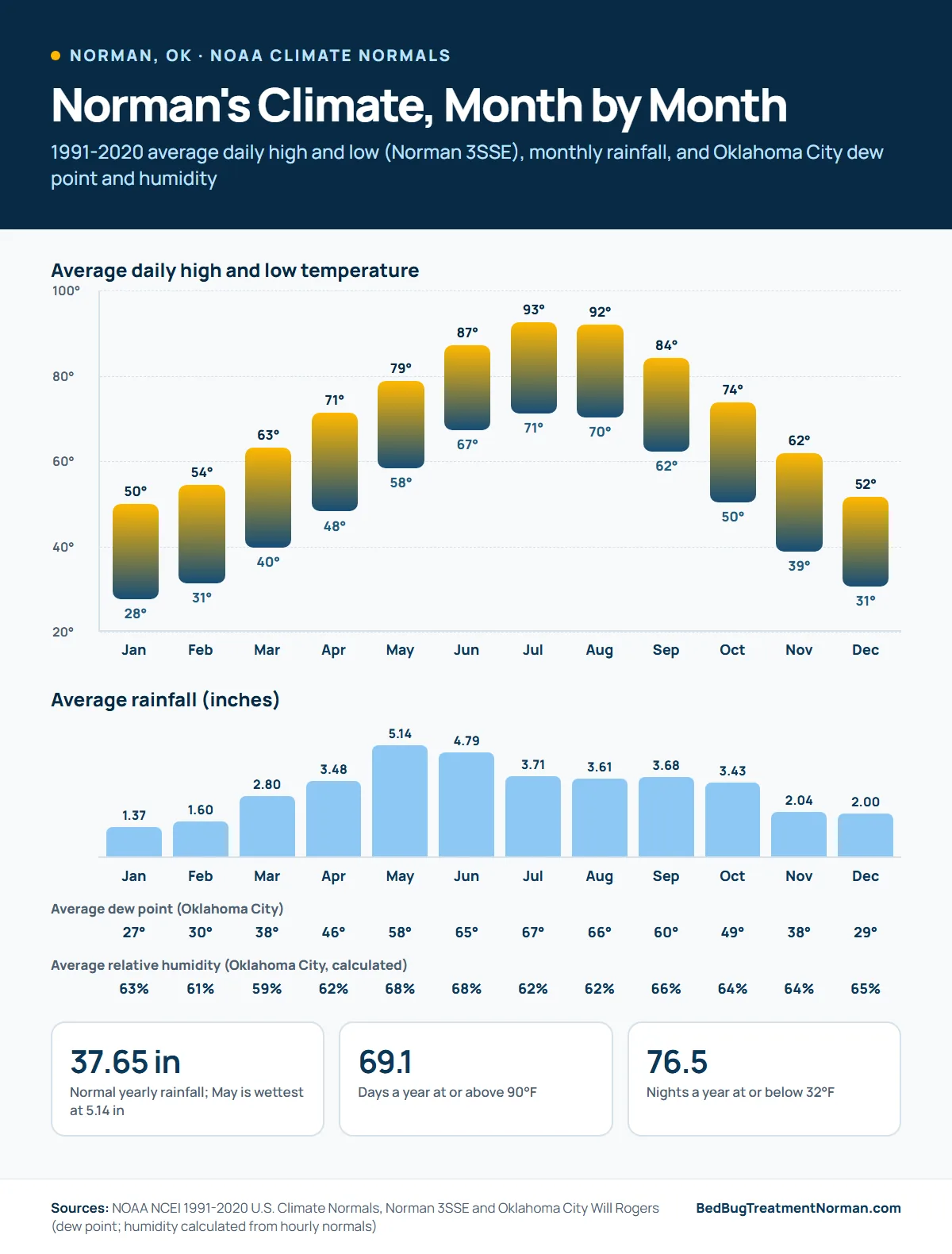
Three things in this table matter most for pests. Spring warms fast: the average high gains 16 degrees between March and May. Summer stays muggy, with dew points above 65°F from June through August, and Norman sees 22 days of 90-plus heat in both July and August. Then the cold arrives quickly, going from 0.6 freezing nights in October to 8.4 in November and 19.5 in December.
2. The 12-Month Norman Pest Pressure Matrix
The matrix puts each pest's published active window next to Norman's monthly normals. A shaded cell means the sources below describe that pest as active or peaking in that month in Oklahoma. Use it to decide when to inspect, seal or book a treatment, and treat the ratings as a guide, since a warm spring or an early freeze can shift them by weeks.
| Pest | Jan | Feb | Mar | Apr | May | Jun | Jul | Aug | Sep | Oct | Nov | Dec |
|---|---|---|---|---|---|---|---|---|---|---|---|---|
| Avg high (°F) | 50 | 54 | 63 | 71 | 79 | 87 | 93 | 92 | 84 | 74 | 62 | 52 |
| Termite swarms | - | - | High | Peak | Peak | Low | - | - | Low | Low | - | - |
| Mosquitoes | - | - | Low | Mod | High | High | Peak | Peak | Peak | High | Low | - |
| Ticks | Low | Low | Mod | High | Peak | Peak | Peak | High | High | Mod | Low | Low |
| Brown recluse | Low | Low | Mod | Mod | High | High | Peak | Peak | High | Mod | Low | Low |
| Scorpions | - | - | Low | Mod | Mod | High | Peak | Peak | High | Mod | Low | - |
| Rodents indoors | Peak | High | Mod | Low | Low | Low | Low | Low | Mod | High | Peak | Peak |
| Bed bugs | Mod | Low | Mod | Mod | High | High | Peak | Peak | High | Mod | Mod | Mod |
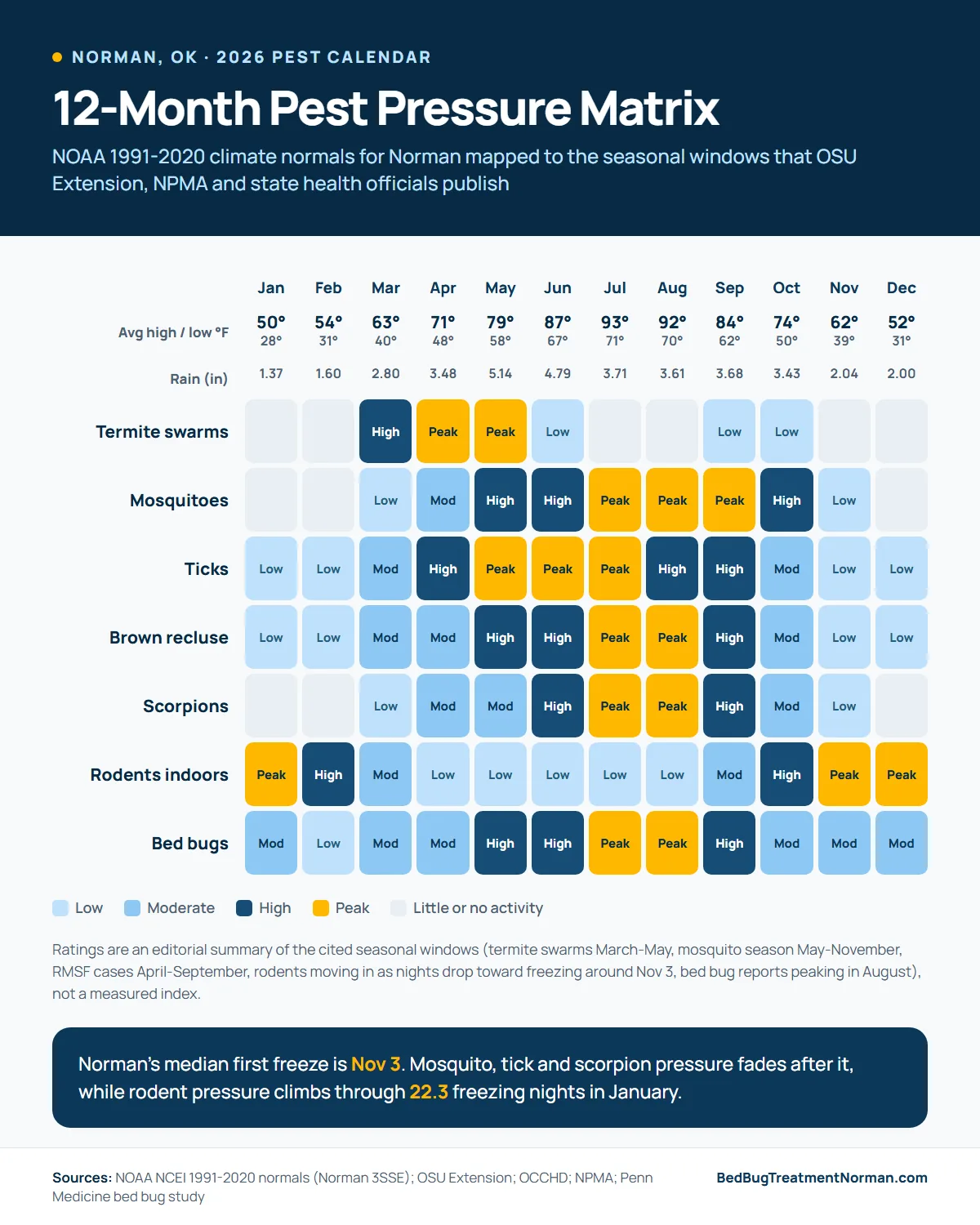
Each rating is tied to a weather threshold that a source names:
| Climate trigger | Pest response | When it hits Norman | Source |
|---|---|---|---|
| Spring warmth and rain | Termite swarms in March, April and May | Highs climb from 63°F to 79°F over those months | OSU |
| Temperatures above 50°F; thriving above 70°F | Mosquitoes become active, then thrive | Average temperature tops 50°F in March (51.5°F) and 70°F in June (77.3°F) | Fixr |
| Hot summer months | Culex mosquitoes go from egg to adult in 4-10 days | 44.4 days of 90°F+ in July and August | OSDH |
| Rising summer heat | Scorpions move out of hot attics and walls into cooler living areas | Highs above 87°F June through August | OSU Extension |
| 70-80°F | Bed bugs can mature in about a month | Typical indoor temperatures all year | UK Entomology |
| First fall freeze | West Nile threat tends to fade | Median November 3 | OSDH spokesman |
| Cooling fall temperatures | Mice most likely to invade buildings | 8.4 freezing nights in November, 19.5 in December | ICWDM |
| Cold weather | Scorpions turn sluggish and stop entering homes | 59 freezing nights from December to February | OSU Extension |
The matrix shows two hand-offs. In late spring, termite swarms give way to mosquitoes and ticks as May rains arrive. In fall, outdoor biters fade while rodents start looking for a way in. Bed bugs sit across both, because they live indoors where the thermostat sets the temperature, though travel and moving seasons still push their numbers up in summer (sections 10 and 11).
3. The Most Common Pests in Norman, OK
No agency publishes a pest count for Norman itself, so the best local signals are OSU Extension's species guides and Orkin's annual city rankings, which are based on the treatments Orkin performs in each metro area. Oklahoma City, whose metro includes Norman, appears on three of Orkin's lists.
| Pest | Peak months in Oklahoma | Local signal | Source |
|---|---|---|---|
| Subterranean termites | Swarms March-May | OKC No. 31 on Orkin's 2025 termite list, its first time in the top 50 | Orkin |
| Mosquitoes | May-November | OKC No. 24 (up 12) and Tulsa No. 32 on Orkin's 2025 mosquito list | Orkin |
| Lone star tick | Early spring to late fall | The tick most commonly met by people in Oklahoma | OSU Extension |
| Brown recluse and black widow | Warm months; indoors all year | The only 2 spiders in Oklahoma considered dangerous to people | OSU Extension |
| Striped bark scorpion | Summer | Oklahoma's most common scorpion is about 2 inches long | OSU Extension |
| House mice and rats | Fall and winter | OKC is not in Orkin's 2026 top 50 rodent cities | Orkin via USA Today |
| Bed bugs | All year, peak in summer | OKC No. 24 on Orkin's 2026 bed bug list, up 10 spots | Orkin |
Rankings: Orkin 2025 bed bug cities (treatments May 15, 2024 to May 14, 2025) and Orkin 2026 bed bug cities (May 12, 2025 to May 12, 2026).
Orkin's lists reflect one company's treatment volume, not a census of infestations, so a ranking change can also mean more customers. Still, the direction matches the national surveys in section 10. For Norman households, the seasonal pests on this list come and go with the weather, while the bed bug is the one most likely to need professional treatment in any month.
4. When Do Termites Swarm in Norman? Spring Swarm Statistics
Subterranean termites are Oklahoma's main structural pest, and spring is when homeowners notice them. Mature colonies send out winged swarmers to start new colonies, and those swarmers often turn up indoors near windows and light fixtures. OSU names March, April and May as the swarming months, which in Norman are also the months when rain days pick up and highs move into the 70s.
| Metric | Value | Source |
|---|---|---|
| Oklahoma termite swarming months | March, April, May | OSU Agricultural Communications |
| Swarm timing | Spring, occasionally fall | OSU Extension |
| Swarmer size | 1/4-3/8 inch, coal black to pale yellow-brown | OSU Extension |
| Mud tube width on foundations | 1/4-1/2 inch | OSU Extension |
| Lifespan of some kings and queens | Up to 25 years | OSU Extension |
| Norman days with 0.10+ in of rain: March / April / May | 4.5 / 4.9 / 7.2 | NOAA NCEI |
| U.S. termite property damage a year | $6.8 billion (estimated) | NPMA, 2026 |
| Homeowners aware of termite damage to structures | 58% | NPMA / Harris Poll, 2026 |
| Homeowners familiar with signs of termites | 36% | NPMA / Harris Poll, 2026 |
| Homeowners who think prevention costs less than repair | 45% | NPMA / Harris Poll, 2026 |
| Oklahoma City on Orkin's termite list, 2025 | No. 31 | Orkin |
Swarmers are often mistaken for flying ants. If you see them inside, or find piles of shed wings on a windowsill, a mature colony is likely close by. OSU notes that termites feed slowly, so there is time to get an inspection and compare quotes. Norman providers reported a termite perimeter treatment at about $7.13 per linear foot, one of the local prices collected in our Norman pest control cost index.
5. When Is Mosquito Season in Oklahoma? Norman Mosquito Data
Mosquitoes need standing water and warmth. Norman gets both from May onward: May is the wettest month, and average temperatures stay above 68°F from May through September. Health officials track the season through West Nile virus, the main mosquito-borne disease in Oklahoma.
| Metric | Value | Source |
|---|---|---|
| Typical Oklahoma mosquito season | May to November | OCCHD |
| Months of greatest West Nile exposure risk | July through October | OCCHD |
| Oklahoma mosquito season in a national cost guide's chart | March to September | Fixr |
| Mosquito species in Oklahoma / in the U.S. | 60 / 230 | OSDH |
| Mosquito species that have tested positive for West Nile | 39+ | OSDH |
| Culex mosquito, egg to adult in hot months | 4-10 days; adults live about 3 weeks | OSDH |
| Asian tiger mosquito, egg to adult in hot months | 24 days; first found in Oklahoma in 1990 | OSDH |
| Oklahoma West Nile cases: 2012 / 2023 / 2024 | 191 / 54 / 41 | CDC and OSDH data via Pawhuska Journal-Capital |
| Cleveland County West Nile case reported in 2026 | 1 of the state's first 2 | OSDH via KOKH Fox 25 |
| People infected with West Nile who never get sick | 8 in 10 | OSDH via KOKH Fox 25 |
| Oklahoma City / Tulsa on Orkin's 2025 mosquito list | No. 24 / No. 32 | Orkin |
For Norman, the overlap of warm nights and late-summer heat explains the July-October risk window. Average lows stay above 62°F from June through September, and the state health department's District 3 spokesman told the Pawhuska Journal-Capital that the West Nile threat tends to fade with the first fall freeze. Emptying standing water weekly does more than any single spray, because it removes the breeding sites that turn over in days.
6. Mosquito Barrier Spray Costs: Per Visit and Per Season
Most mosquito service is a barrier spray on shrubs and shaded areas, repeated every few weeks. Angi says each application protects for two to four weeks. The commonly quoted figures of about $350-$700 a season and $75-$150 a visit hold up against the published guides, and one Norman-specific price is available from a local provider survey.
| Service | Price | Area | Source |
|---|---|---|---|
| Full season of treatment | $373-$694 | National | Fixr |
| Average, per treatment or season | $350; most spend $200-$550 | National | Angi |
| Barrier spray, per treatment | $70-$150 | National | Angi |
| Mosquito company visit, average | $80-$150 | National | HomeGuide |
| Barrier spray, per visit | $125-$165 | National | HomeGuide |
| Mosquito treatment, 1/4-acre yard | $131.45 ($107.38-$155.51) | Norman | ProMatcher Norman |
| Mosquito treatment, typical job | $109-$198; most pay about $134 | National | LawnStarter |
| One-time treatment | $135-$251 | National | Fixr |
| Monthly service, per year | $500-$1,000 | National | Angi |
| Seasonal package, per year | $600-$1,200 | National | Angi |
| Misting system | $1,200-$2,500 install; $400-$700 a year upkeep | National | Angi |
| Tick control add-on | $75-$200 per visit | National | Angi |
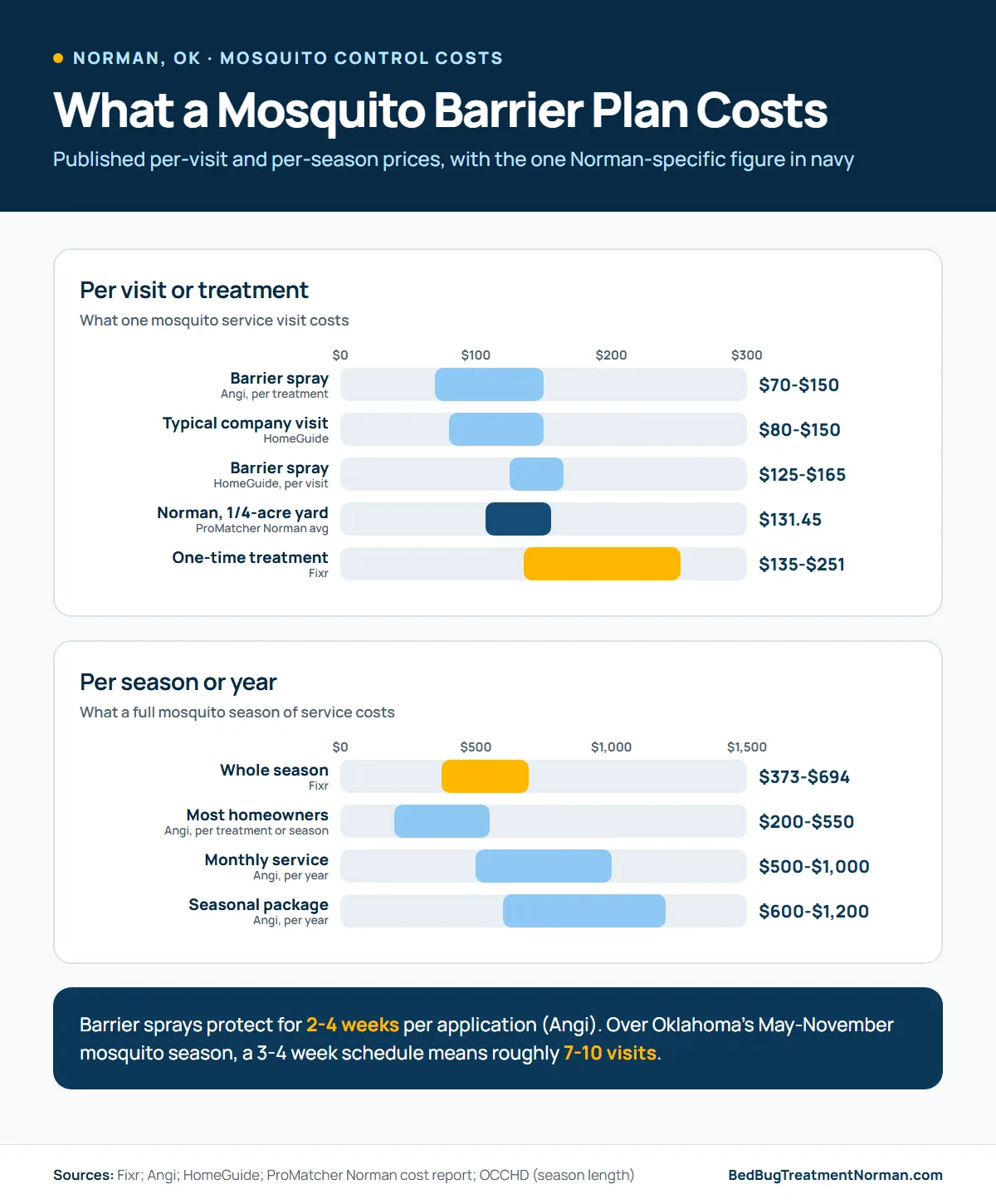
How many visits does a Norman season need? OCCHD's May-November season is about 30 weeks. At Angi's recommended interval of every three to four weeks, that comes to roughly 7-10 visits. The table below is our arithmetic from those published inputs.
| Schedule | Visits, May-November | At $80-$150 a visit (calculated) |
|---|---|---|
| Every 4 weeks | About 7 | $560-$1,050 |
| Every 3 weeks | About 10 | $800-$1,500 |
| Fixr's published season price | Varies by region | $373-$694 |
Because Norman's season runs longer than the national April-to-October window HomeGuide describes, ask any quote how many visits it includes and what it costs to add October or November. Mosquito and tick work is outside this site's scope; the referral line connects callers with bed bug providers only.
7. Tick Season in Oklahoma: Spotted Fever and Ehrlichiosis Data
Ticks are the outdoor pest with the clearest public health record in Oklahoma. The state is one of the main hot spots for Rocky Mountain spotted fever, and the lone star tick that carries ehrlichiosis is the tick people here meet most often. Their season starts earlier than mosquitoes and peaks in late spring.
| Metric | Value | Source |
|---|---|---|
| Lone star tick active season | Early spring to late fall | OSU Extension |
| Eggs laid by one lone star female | 9,000-12,000 | |
| Oklahoma RMSF cases | April-September, peak May-July | |
| Share of U.S. RMSF cases from Oklahoma and North Carolina | More than 1/3 | |
| American dog tick, the only known RMSF vector in Oklahoma | Most active in spring and early summer | |
| Ticks infected with RMSF in most areas | Fewer than 1 in 1,000 | |
| RMSF patients who develop the spotty rash | About 50% | |
| Heartland virus cases (as of Nov 2022) | 60+ in 14 states, including Oklahoma; April-September | |
| Tick reduction from rodent bait boxes around homes | More than 50% | |
| Ehrlichiosis cases | Most occur May-September | OCCHD fact sheet |
| Black-legged tick adults | Active late September to March or April | OSU Extension |
In Norman, the RMSF peak lines up with the months when highs run from 79°F to 93°F and yards are in full use. OSU stresses that ticks usually have to feed for hours before they pass on disease, so a tick check after time outdoors matters more than panic. Ticks found indoors are almost always carried in on people or pets; the brown dog tick, which OSU calls very common in Oklahoma, is the main exception and can breed around dog bedding.
8. Brown Recluse Statistics for Oklahoma, Plus Scorpions
OSU Extension says only two Oklahoma spiders are dangerous to people: the brown recluse and the black widow. The brown recluse is the one most likely to live inside a Norman home, in closets, boxes and stored clothing. Its numbers build through summer as egg cases hatch.
| Metric | Value | Source |
|---|---|---|
| Spiders in Oklahoma considered dangerous to people | 2 (brown recluse, black widow) | OSU Extension |
| Adult brown recluse body length | About 1/2 inch | |
| Brown recluse spiderlings emerge from egg cases in summer | 24-36 days | |
| Spiderlings per brown recluse egg case | 40 or more | |
| Black widow egg cases per female each summer | 4-9, with 25-900 eggs each (300-400 common) | |
| Antivenom available | Black widow only | |
| Brown recluses collected in one Kansas home in 6 months | 2,055; at least 400 large enough to bite | Vetter & Barger, J. Med. Entomol. (2002) |
| Brown recluses collected in a typical infested Oklahoma home | 30 (Missouri home: 45) | |
| Bites recorded among residents of those three homes | 0 | |
| Scorpion species in the continental U.S. | About 50, most in the Southwest | OSU Extension |
| Length of Oklahoma's most common scorpion | About 2 inches | |
| Scorpion gestation | 5 months to over a year | |
| Winter scorpion activity indoors | Rare; winter finds are usually summer visitors that never left |
OSU says people are usually bitten when they put on clothes or shoes a spider is hiding in, roll onto one in bed, or clean out storage. That is also why bites get misread. Unexplained bites in bed are more often bed bugs than spiders, and a professional bed bug inspection will tell you which you are dealing with before you pay to treat. OSU adds that brown recluse control often takes more than one treatment. Scorpions follow the heat: as summer temperatures rise they move out of attics and wall voids into cooler kitchens and bathrooms, then go quiet once winter arrives.
9. First Frost and the Winter Rodent Surge in Norman
NPMA estimates that rodents invade 21 million U.S. homes each winter. That is a national figure, and Norman's share of it depends on when winter actually starts here. NOAA's freeze probabilities answer that: the first 32°F night arrives around November 3 in a typical year, and by mid-November it has almost certainly happened.
| Metric | Value | Source |
|---|---|---|
| Median first fall freeze (32°F), Norman | November 3 | NOAA NCEI, Norman 3SSE |
| Chance of a first freeze by October 21 / November 17 | 10% / 90% | |
| Median first hard freeze (28°F) | November 12 | |
| Median last spring freeze | April 3 (10% chance after April 18) | |
| Nights at or below 32°F a year | 76.5 | |
| Freezing nights falling November-March (calculated) | 74.7 (98%) | |
| Median first fall freeze, Oklahoma City airport | November 2 | NOAA NCEI, OKC Will Rogers |
| U.S. homes invaded by rodents each winter | 21 million (estimated) | NPMA |
| Homeowners reporting mice infestations in winter | 24% | |
| House mouse litters a year / young per litter | 5-10 / 5-6; 19-day gestation | OSU Extension |
| Descendants one rat pair can produce in a year | 15,000 | |
| Age at which house mice can breed | 6-10 weeks | ICWDM |
| Rodent inspection and initial trap setting | $147.19 average | ProMatcher Norman |
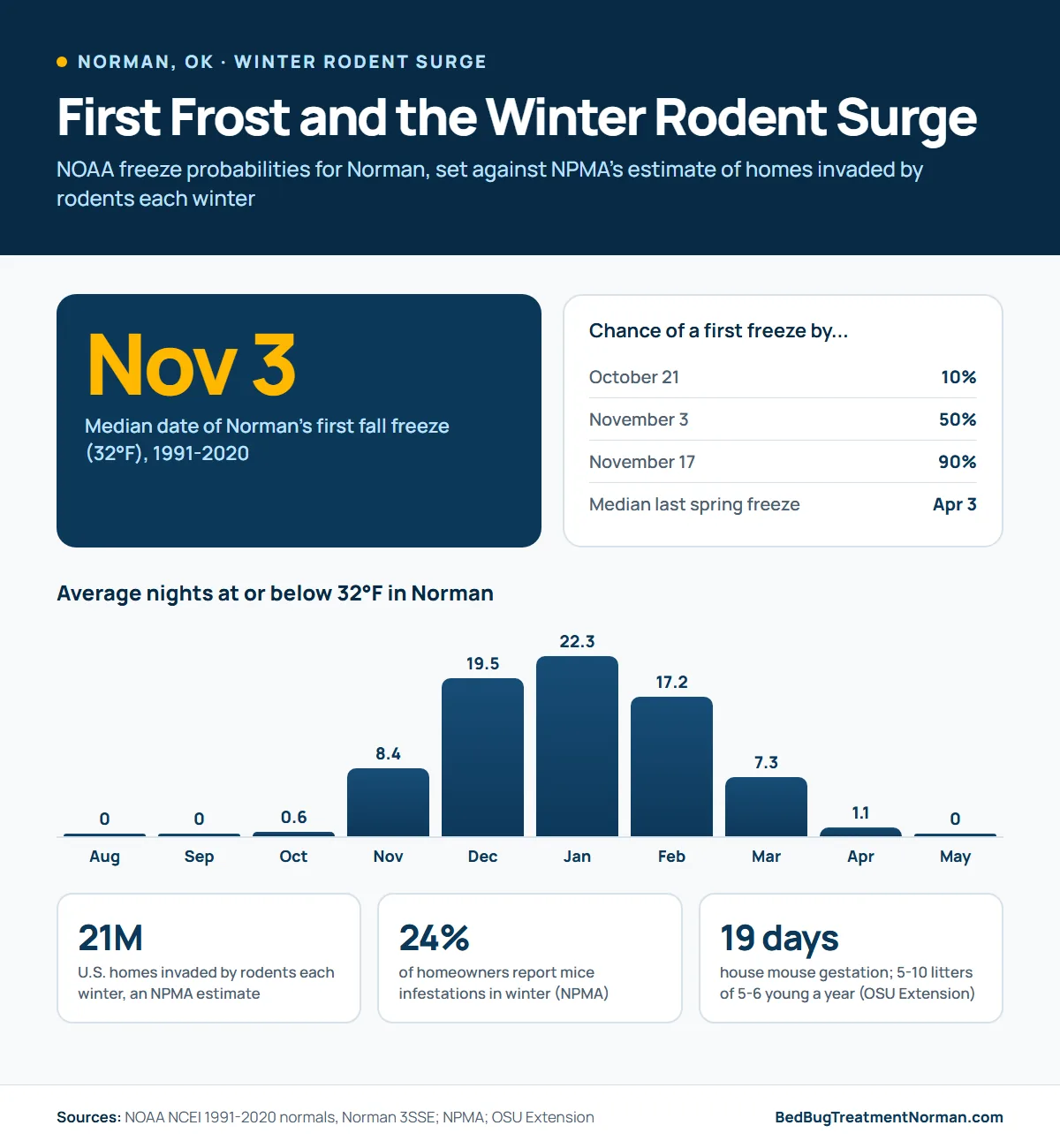
Put the numbers together and Norman's rodent window is clear. Almost all of the city's freezing nights (98%) fall between November and March, and January alone averages 22.3. With a 19-day gestation and up to 10 litters a year, a pair of mice that gets inside in early November can have young of their own before spring. NPMA's checklist is the same one providers give: seal cracks and holes outside, look for gnaw marks on wires and insulation, and keep firewood 20 feet from the house and 5 feet off the ground. Oklahoma City was not on Orkin's 2026 list of the 50 rattiest cities, so Norman's rodent pressure is seasonal rather than extreme.
10. Bed Bug Seasonality: The Summer Surge and Travel Peaks
Bed bugs do not hibernate and do not care about frost, because they live where people sleep. Even so, the data shows a clear summer rise. The best-documented seasonal study tracked four years of bed bug reports to Philadelphia's health department, and pest professional surveys point the same way.
| Metric | Value | Source |
|---|---|---|
| Month bed bug reports peaked / bottomed out | August / February | Mabud et al., J. Med. Entomol. (2014) |
| Growth in Philadelphia bed bug reports, 2008-2012 | 4.5% a month (about 69% a year) | |
| Pest pros who say bed bugs are most active in summer | 51% | PPMA Bugs Without Borders, 2018 |
| Customers who first call after noticing bites or welts | 55% | |
| Pros called for another pest who found bed bugs instead | 84% (fleas the top mix-up, 71%) | |
| Single-family homes where bed bugs were found in the primary bedroom / living room | 97% / 88% | |
| Pros who say bed bugs are the hardest pest to control | 62% | |
| Pros who noted seasonal differences, with summer the peak | 61% | NPMA Bugs Without Borders, 2015 |
| Time for bed bugs to mature at 70-80°F | As little as a month; eggs hatch in about a week | University of Kentucky Entomology |
| Survival without feeding at 55°F or less / in heated buildings | Up to a year / about 1-4 months | |
| People who show no reaction to bites | About 30% | |
| Americans who check hotel rooms for bed bugs | 28% | NPMA / Harris Poll, 2025 |
| Americans who can identify a bed bug / know how to inspect | 32% / 30% | NPMA / Harris Poll, 2026 |
| Thanksgiving travelers going 50+ miles, 2025 (record) | 81.8 million; about 73 million by car | AAA |
Two Norman facts sharpen that pattern. Indoor temperatures sit in the 70-80°F range where bed bugs develop fastest, and summer brings trips, guests and moves. The cold months do not end an infestation either: bed bugs can go months without feeding, so a quiet winter is often a pause, not a cure. Providers usually treat with heat that raises rooms to lethal temperatures in one visit, or with targeted chemical treatment over several visits, and both work in any month.
11. OU Move-In, Move-Out and Holiday Travel: Norman's Bed Bug Calendar
Norman is a university town, and the University of Oklahoma's calendar moves thousands of mattresses, couches and suitcases at set times each year. Bed bugs ride along on luggage and used furniture, so these dates are worth knowing whether you live in a residence hall, rent near campus or own a house that hosts visiting family.
| Date or metric | Value | Source |
|---|---|---|
| OU freshman class, fall 2025 (record) | 6,251 | OU Admissions |
| OU total enrollment, all campuses, fall 2025 | 36,500+ | |
| Increase in total fall enrollment at the Norman campus, as reported by OU in 2025 | 16% | |
| Spring 2026 classes began / spring vacation | January 20 / March 16-20 | OU Registrar, spring 2026 |
| Spring 2026 final exams / commencement weekend | May 11-15 / May 15-17 | |
| Fall 2026 classes begin / final exams | August 24 / December 14-18 | OU Registrar, fall 2026 |
| Spring 2027 residence hall move-in | January 1-18 (first-year students from January 13) | OU Housing and Food |
| Pest pros who treated bed bugs in college dorms in the past year | 36% | NPMA / UF survey, 2025 |
| Pros who treated bed bugs in apartments and condos / hotels | 88% / 70% | |
| Norman homes that are rented | 46.7% | U.S. Census QuickFacts |
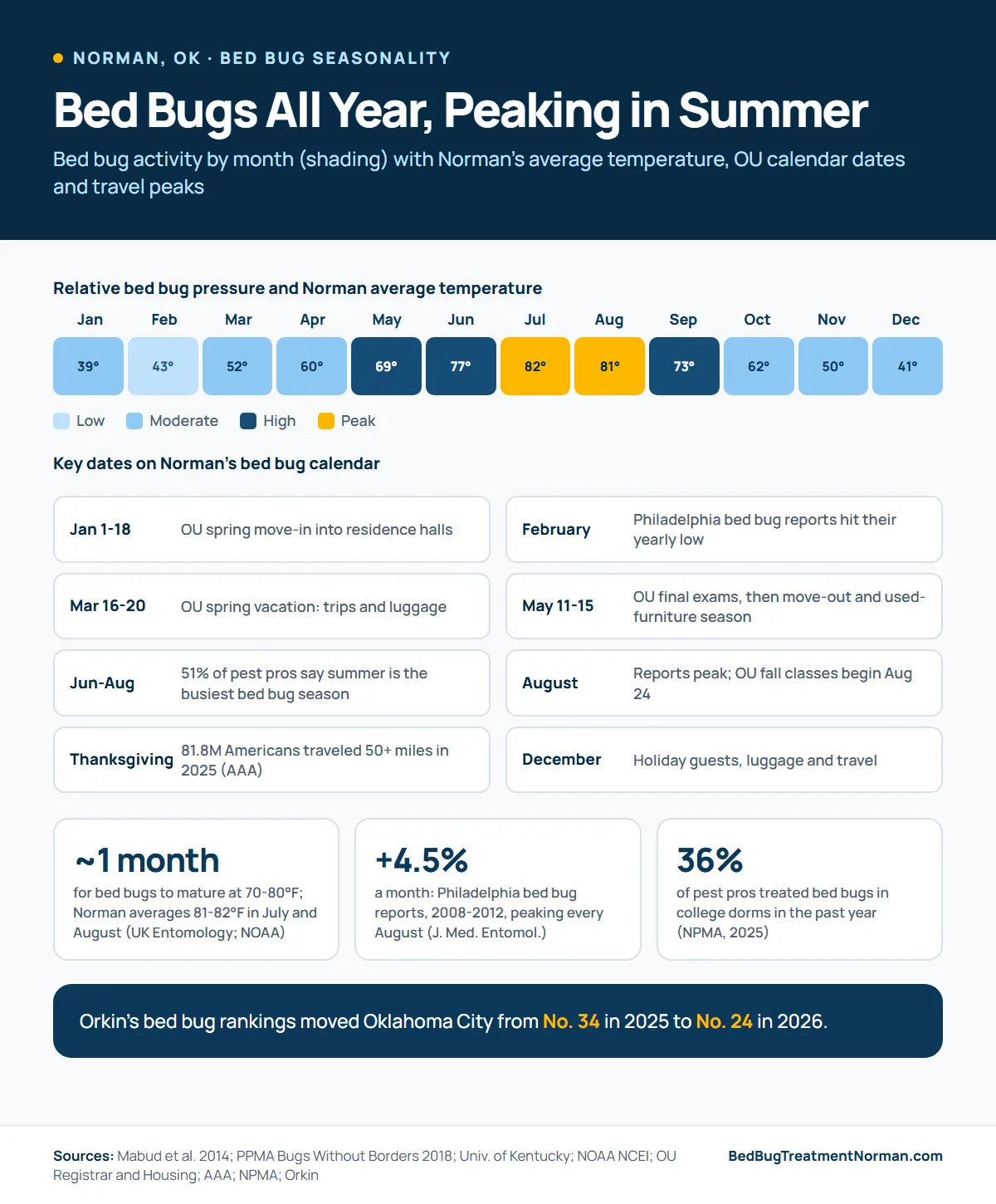
May is the riskiest month for secondhand furniture, as leases end after finals and couches and mattresses land on curbs. August brings the reverse: new tenants, new furniture and luggage from summer trips arriving in the hottest month. For renters, apartment bed bug treatment works best when neighboring units are checked too, and with nearly half of Norman homes rented, that is a common situation. Holiday travel adds a smaller winter bump: a record 81.8 million Americans traveled for Thanksgiving in 2025, and guests' suitcases go straight into spare bedrooms.
12. Month-by-Month Norman Pest Prevention Calendar
This calendar turns the matrix into a to-do list. The timing comes from the NOAA normals and the seasonal windows cited above; adjust it when a year runs warm or cold.
| Months | Norman weather (normals) | What is active | What to do |
|---|---|---|---|
| Jan-Feb | Highs 50-54°F; 39.5 freezing nights | Rodents indoors; bed bugs at their low | Check attics and pantries for droppings; inspect after OU spring move-in |
| Mar-Apr | Highs 63-71°F; last freeze around Apr 3 | Termite swarms begin; ticks wake up | Watch windowsills for shed wings; book a termite inspection |
| May | 5.14 in of rain, the year's wettest month | Swarms end; mosquitoes and ticks climb | Empty standing water weekly; check secondhand furniture after move-out |
| Jun-Aug | Highs 87-93°F; 56.2 days at 90°F+ | Peak mosquitoes, ticks, scorpions, recluses and bed bugs | Tick checks after yard work; inspect luggage after trips; check beds after August move-in |
| Sep-Oct | Highs 74-84°F; first freeze possible by Oct 21 | West Nile risk stays high; mice start scouting | Seal gaps, vents and utility openings before late October |
| Nov-Dec | Median first freeze Nov 3; 27.9 freezing nights | Rodent surge; holiday travel | Set traps if you see droppings; check guest beds after holiday visitors |
Freezing nights and 90-degree days are sums of the monthly NOAA normals for Norman 3SSE (our arithmetic).
For bed bugs, the calendar is simpler: check after every trip, every move and every secondhand purchase, whatever the month. If treatment is needed, ask how many visits it includes and when the follow-up visit happens, since a winter lull can hide survivors. The referral line covers every Norman ZIP code listed on the service areas page, including 73019 on the OU campus.
Norman Seasonal Pest Statistics Summary Table
| Statistic | Value | Source |
|---|---|---|
| Median first fall freeze, Norman | November 3 | NOAA NCEI |
| Chance of first freeze by Oct 21 / Nov 17 | 10% / 90% | NOAA NCEI |
| Median last spring freeze | April 3 | NOAA NCEI |
| Yearly rain / 90°F+ days / freezing nights | 37.65 in / 69.1 / 76.5 | NOAA NCEI |
| Hottest month average high / coldest month average low | 92.5°F (Jul) / 27.7°F (Jan) | NOAA NCEI |
| Termite swarming months | March-May | OSU |
| U.S. termite damage a year | $6.8 billion | NPMA |
| Mosquito season / peak West Nile risk | May-Nov / Jul-Oct | OCCHD |
| Oklahoma mosquito species | 60 | OSDH |
| Oklahoma West Nile cases, 2024 | 41 | CDC / OSDH |
| Mosquito control per season / per visit | $373-$694 / $80-$150 | Fixr / HomeGuide |
| Norman mosquito treatment, 1/4 acre | $131.45 | ProMatcher |
| RMSF cases / peak | Apr-Sep / May-Jul | OSU Extension |
| Ehrlichiosis cases | May-Sep | OCCHD |
| Brown recluses in one Kansas home / typical Oklahoma home | 2,055 / 30 | J. Med. Entomol. |
| U.S. homes invaded by rodents each winter | 21 million | NPMA |
| Bed bug reports peak / low | August / February | Mabud et al. |
| Pros who say bed bugs peak in summer | 51% | Bugs Without Borders |
| Oklahoma City on Orkin's bed bug list, 2025 / 2026 | No. 34 / No. 24 | Orkin |
| OU record freshman class, fall 2025 | 6,251 | University of Oklahoma |
Methodology & Sources
We collected this data in November 2026. Weather figures are NOAA NCEI 1991-2020 U.S. Climate Normals for the Norman 3SSE station (USC00346386); dew point comes from the hourly normals for Oklahoma City Will Rogers airport (USW00013967), the nearest station with humidity data, and monthly relative humidity is our calculation from its hourly temperature and dew point normals. Pest season windows come from OSU Extension, the Oklahoma State Department of Health, the Oklahoma City-County Health Department and ICWDM. Survey and ranking figures come from NPMA, PPMA, the University of Kentucky, Orkin, AAA, the University of Oklahoma and the U.S. Census Bureau. Cost figures come from Fixr, Angi, HomeGuide, LawnStarter and ProMatcher. The pest pressure ratings, visit counts, seasonal totals and percentages labeled "calculated" are our own work from those figures. Orkin rankings reflect one company's treatment volume. None of these figures is a quote.
- NOAA NCEI -- Monthly normals, Norman 3SSE
- NOAA NCEI -- Annual and seasonal normals, Norman 3SSE
- NOAA NCEI -- Hourly normals, Oklahoma City
- NOAA NCEI -- Annual and seasonal normals, Oklahoma City
- NOAA NCEI -- About the U.S. Climate Normals
- OSU -- Be on the lookout for termites
- OSU Extension -- Subterranean termite
- OSU Extension -- Common ticks of Oklahoma
- OSU Extension -- Brown recluse, black widow and other spiders
- OSU Extension -- Scorpions
- OSU Extension -- Rodent control
- Oklahoma State Department of Health -- Mosquito protection
- Oklahoma State Department of Health -- West Nile virus
- Oklahoma City-County Health Department -- West Nile virus
- Oklahoma City-County Health Department -- Ehrlichiosis fact sheet
- Pawhuska Journal-Capital -- West Nile season, 2025
- KOKH Fox 25 -- 2026 West Nile cases
- ICWDM -- House mouse biology
- NPMA -- Winter pest-proofing against rodents
- NPMA -- Termite Awareness Week survey, 2026
- NPMA -- 2025 bed bug facts
- NPMA -- Bed Bug Awareness Week survey, 2026
- NPMA -- Bugs Without Borders, 2015
- PCT -- Bugs Without Borders survey, 2018
- Mabud et al. -- Bed bug reporting in Philadelphia (2014)
- PCT -- Seasonal pattern for bed bug infestations
- Vetter & Barger -- 2,055 brown recluse spiders (2002)
- University of Kentucky Entomology -- Bed bugs
- Orkin -- 2025 bed bug cities
- Orkin -- 2026 bed bug cities
- Orkin -- 2025 mosquito cities
- Orkin -- 2025 termite cities
- USA Today -- Orkin rattiest cities, 2026
- Fixr -- Mosquito control cost
- Angi -- Mosquito control cost
- HomeGuide -- Mosquito control cost
- LawnStarter -- Mosquito treatment price
- ProMatcher -- Norman pest control cost report
- AAA -- Thanksgiving travel forecast, 2025
- University of Oklahoma -- Record incoming class, 2025
- OU Registrar -- Spring 2026 calendar
- OU Registrar -- Fall 2026 calendar
- OU Housing and Food -- Move-in
- U.S. Census Bureau -- QuickFacts, Norman city
Norman Seasonal Pest FAQ
What are the most common pests in Norman, OK?
Norman's pests follow the seasons: subterranean termites swarm in spring, mosquitoes and ticks peak in summer, brown recluse spiders and striped bark scorpions are most active in hot months, and house mice and rats move indoors as nights turn cold. Bed bugs live indoors and turn up in every month. Oklahoma City ranked No. 31 on Orkin's 2025 termite list, No. 24 on its 2025 mosquito list and No. 24 on its 2026 bed bug list.
When is mosquito season in Oklahoma?
The Oklahoma City-County Health Department says mosquito season in Oklahoma typically runs from May to November, and people are at greatest risk of exposure to West Nile virus from July through October. Oklahoma has about 60 mosquito species. The state reported 41 West Nile cases in 2024 and 54 in 2023.
When is tick season in Oklahoma?
The lone star tick, the one Oklahomans meet most often, is active from early spring to late fall, according to OSU Extension. Most Rocky Mountain spotted fever cases in Oklahoma occur from April through September, with the peak in May, June and July, and most ehrlichiosis cases occur from May through September.
When do termites swarm in Norman?
OSU Extension names March, April and May as Oklahoma's termite swarming months. In Norman, average daily highs climb from 63 degrees F in March to 79 degrees F in May, and May is the wettest month at 5.14 inches of rain (NOAA 1991-2020 normals). Swarmers indoors usually mean a mature colony is nearby.
When do mice and rats invade homes in Norman?
Mice are most likely to move indoors as temperatures cool in fall. Norman's median first freeze is November 3, with a 10% chance of one by October 21 and a 90% chance by November 17 (NOAA). December through February average 59 nights at or below 32 degrees F. NPMA estimates rodents invade 21 million U.S. homes each winter.
Are bed bugs seasonal in Norman?
Bed bugs live indoors and are found all year, but reports rise in summer. A Philadelphia study found reports peaked in August and bottomed out in February, and 51% of pest professionals in a 2018 survey said summer is the busiest season. In Norman, summer travel, OU move-out in May and move-in before classes begin in late August add to that peak.
How much does mosquito control cost in Norman?
Fixr puts a full season of mosquito treatment at $373-$694. Single visits run $80-$150 on average (HomeGuide), barrier sprays $70-$150 per treatment (Angi), and Norman providers reported an average of $131.45 to treat a quarter-acre yard (ProMatcher).
Keep Reading
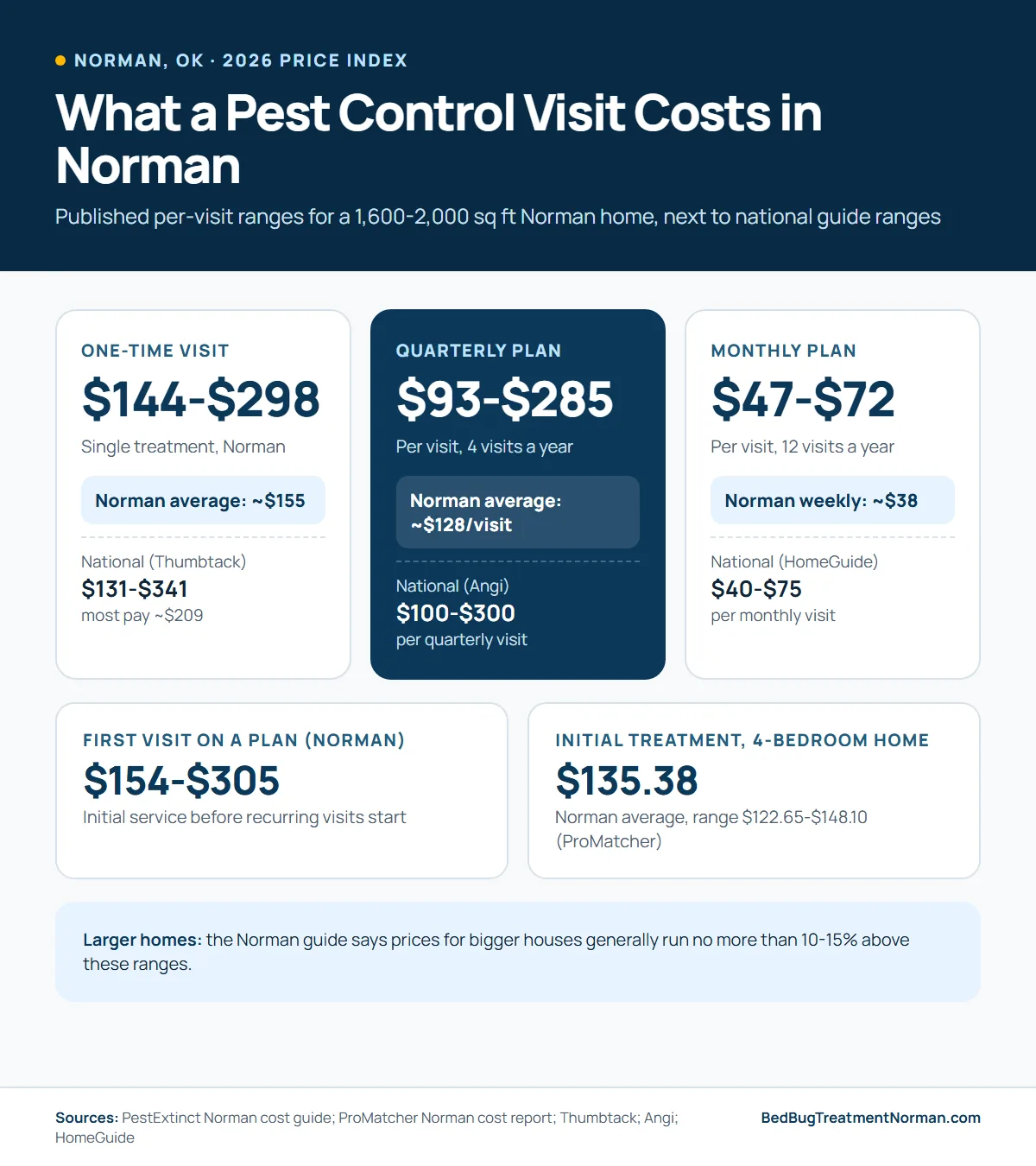
Norman Pest Control Cost Index
One-time, monthly and quarterly prices, plus bed bug treatment costs.
Read more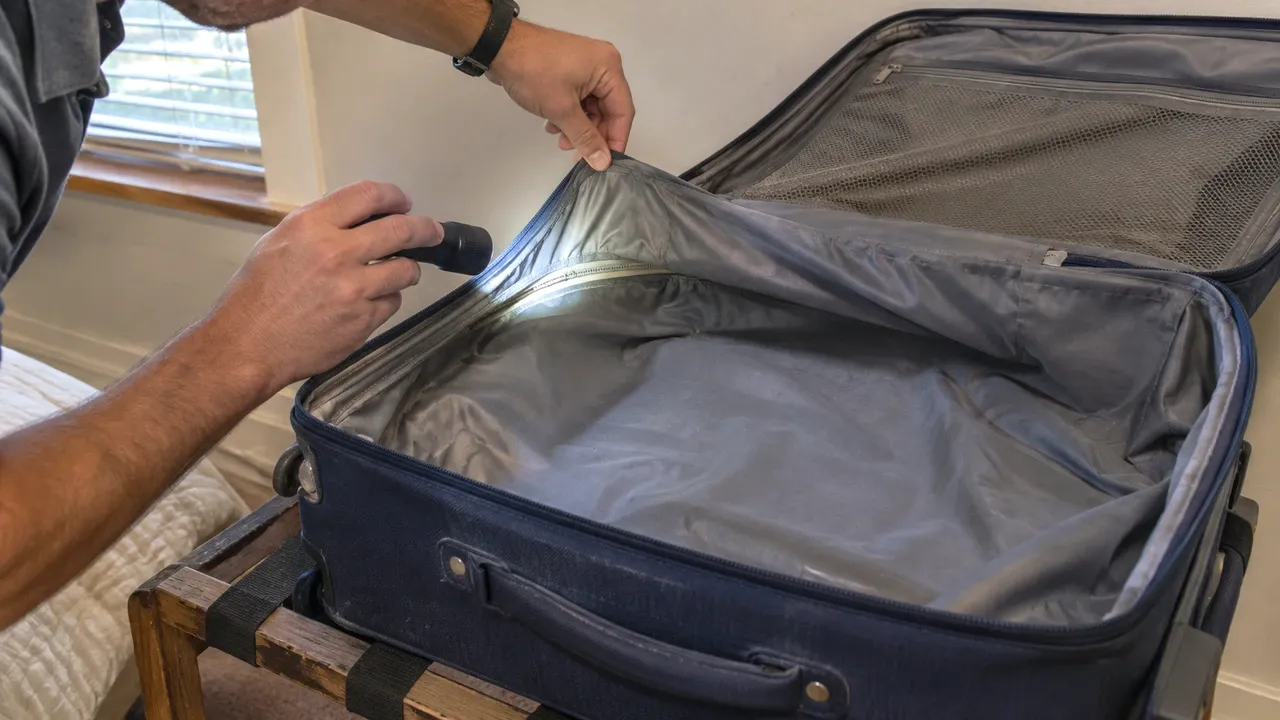
Bed Bug Inspection
Have a provider check after a trip, a move or a used-furniture purchase.
Read more
Apartment Bed Bug Treatment
Treatment plans for units, neighbors and move-in season.
Read moreFound bed bugs after a trip or a move?
One call connects you with an independent Norman bed bug provider. You are not obliged to book.